






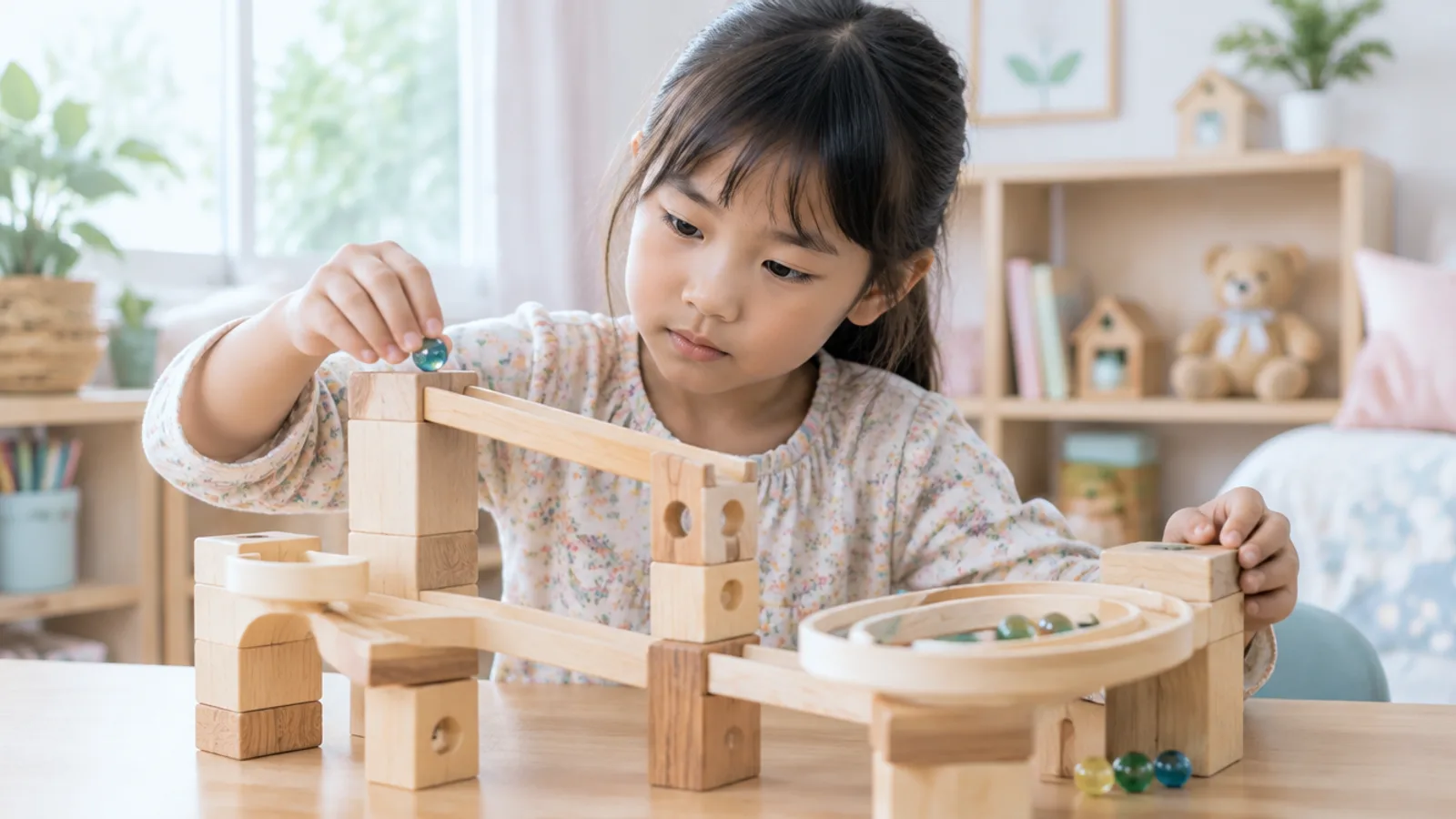
Hape’s Quadrilla marble runs were recognized in The Wall Street Journal as wooden toys that help teach children coding.
In May 2016, an article titled "How Wooden Toys Teach Kids to Code" was written by Michael Hsu, The Wall Street Journal’s gadgets and technology editor.

The article selected Hape’s Quadrilla as a toy that demonstrates how children can use logic and solve problems within a defined structure, explaining why it is particularly well suited to teaching the basics of coding.
As both a marble-run owner and a longtime coder, Hsu observed how the system worked while building Quadrilla tracks with his children:
"Building with Quadrilla’s marble-run system is like coding: first, you need to create a working structure—a track, or a "program".
"Wooden marble runs are hardly cutting-edge technology. But while using this system to build kinetic structures (involving the motion of solid bodies, a branch of dynamics) with my children, I realized how much it could teach about the fundamentals of computer programming, especially the art of fixing errors (Debugging), which becomes even more exciting when lots of marbles are involved."
The combination of marbles and tracks, speed and spinning formed the original idea behind Quadrilla: allowing marbles to travel along a horizontal plane. Hape states that it was the first marble run to achieve this.
In 1999, Braun, a German electronics engineer, was walking through a local Christmas market with his 4-year-old son. Both were captivated by a traditional marble toy, inspiring him to try building one himself with just two tools: a drill and a basic saw.
Without the appropriate tools, he cut grooves along the wood to make tracks for the marbles and holes in the blocks to give the marbles enough speed to travel horizontally. In this first prototype, he created a classic marble run in which the marbles moved from left to right and dropped down one level at a time.
He then gradually drilled two additional holes in each track. These extra openings allowed the marbles to follow more than one route, creating a toy without a fixed path of travel. The lively world of Quadrilla was born.
Quadrilla comes from two German words: "Quader" and "Rille", meaning "a brick (a rectangular block)" and "a groove"—the components of the toy itself. Children building marble runs can discover the wonders of Quadrilla’s structures: marbles travelling along horizontal tracks through 180 degrees, individual coloured blocks and multiple marbles. They can even create tracks that play their own melodies with the Super Spirals set, which includes xylophone keys that can be positioned wherever they like within the structure.
Safety precautions: Quadrilla marble-run sets contain marbles and small parts that younger children could swallow or choke on. The store listing specifies ages 4 and up. Provide adult supervision during play, count and put away all marbles after every session, and keep them out of reach of younger children in the home (Choking Prevention – AAP). If a child is choking and cannot breathe, call 1669 immediately, and read how to give first aid when a child is choking in advance.

Interested in other marble-run models? Read about the Castle Escape marble run and the Medieval Quest marble run.
About The Wall Street Journal: A US English-language daily newspaper based in New York City, focusing on business and economic news.
Source: Hape’s press release, “Quadrilla featured in The Wall Street Journal” (May 2016).
If you are looking for an excellent developmental toy, Hape is a good choice, with a wide range of wooden toys that support children’s development at every age.
Thoughtfully designed with children’s learning in mind, these toys help develop important skills such as seeing, listening, observation, fine motor control, problem-solving, imagination and creativity. They also encourage integrated learning through STEAM.
With durable designs and materials, the toys focus on supporting children’s development while prioritizing their safety. They use non-toxic paints and FSC-certified wood, offering a long useful life while being environmentally friendly.
Hape is therefore a global wooden-toy brand that has received toy awards from numerous organizations and uses production systems based on international standards such as ICTI, ISO 14001 and ISO 9001.
What matters most is sharing happy moments as a family, because wherever there is love, there is a complete home.
Hape Thailand
Love Play Learn
🌐: Browse the full range: All Hape toys
Follow the latest news and special offers: FB : Hape Thailand