







How much do you talk with your child?
Communication means sharing thoughts and feelings, helping us connect with one another. Conversation is therefore essential to every relationship. Even when stressful daily routines make us forget to nurture our family bonds, talking can help.

Mornings often leave little room for conversation. Everyone rushes through breakfast before heading to work or school. Afternoons are much the same: we pick the children up from extra classes, sports, or music lessons, while we are already tired from a full day of work.
In the evening, the adults are busy preparing dinner and clearing the table, while the children hurry through their meal before going online. So… when do we get to play with our children? Or talk with them?
As parents, our role is to care for and guide our children, yet we seem to have no time to talk with them. It can feel as though everything in the universe is keeping us from spending time together as a family.
Communication is one of the fundamental measures of a family's strength, and it needs regular care and attention. It is much like looking after a house or a plant: without regular cleaning, a house gets dirty; without watering and tending the soil, a plant may wither and die.
Family interactions are linked to children's sense of satisfaction as they venture out into the world. A lack of communication, or harmful communication such as sarcasm, hurtful and undermining remarks, and belittling language, often increases family conflict and weakens emotional self-control. Children may carry these habits into school and other social settings. Family communication therefore helps shape how family members interact with others in society. (Read more: 10 Things You Shouldn't Say to Your Child and AAP guidance on communicating with your child)
Remember that strong family relationships are built on warm interactions, love, and responsiveness to one another. These help children feel loved and secure, building inner strength and a positive outlook.
Do not let technology or the busyness of life steal this precious time. Switch off digital devices and start spending more time with your children. Try to create positive conversations: ask how they are doing, encourage them when they feel disappointed or sad, and praise their achievements, however small.
Talking seems like the easiest way to strengthen your relationship, and you do not need to set aside time for a serious sit-down conversation. You can talk while doing chores or eating together. To connect more closely with your children, try playing with them more often, because play offers valuable opportunities for family communication.
Try these tips to start building healthy communication habits in your family!
1. Adjust your daily routine to find opportunities to spend time together
Making room for quality time gives everyone a chance to have fun and get to know one another more deeply. If time is truly limited, use every available opportunity to talk with your child.
If you are driving your child to school in the morning, start a conversation. Turn off the radio and mobile phones, and use the opportunity to talk about the activities planned for the day.
Whenever possible, eat together and make the dinner table a place for quality time. Shared meals help teach children how to communicate. Family meals can become a tradition and routine that children expect and look forward to. Remove technological distractions if you can. Start by talking about what happened today or sharing your feelings. Your child will feel that they matter more to you than the news or whoever you might be talking to on the phone, encouraging them to share their thoughts and feelings with you.
Sharing meals also helps children learn good social manners and healthy eating habits.
Another benefit of conversation is the development of listening skills. It helps build emotional intelligence and the ability to care about and listen to others, enabling children to approach social relationships thoughtfully.
To learn more about why eating together matters, read 7 Benefits of Eating Together as a Family.
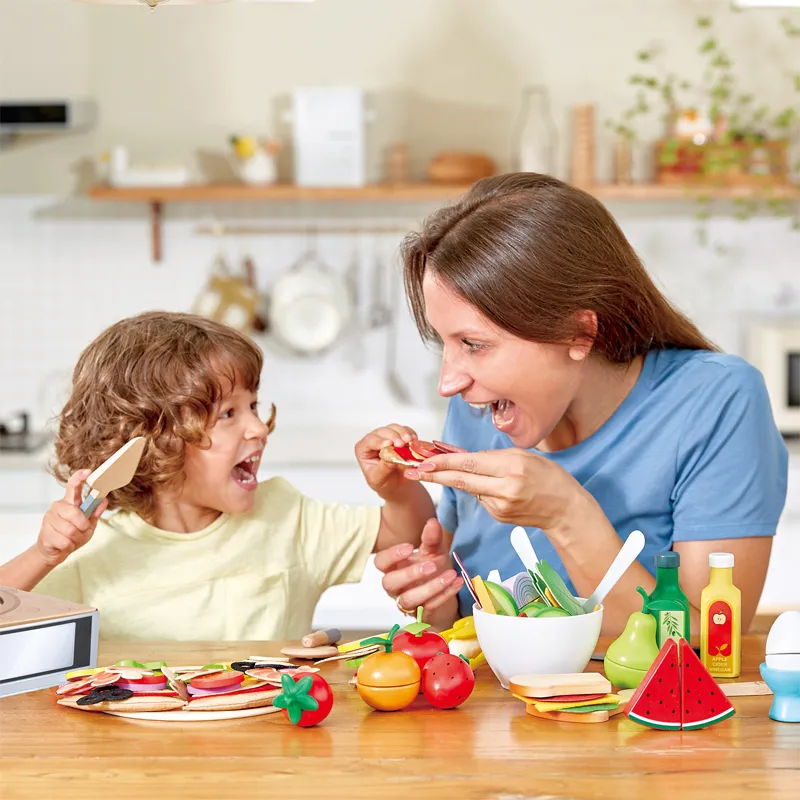
Cooking together is another activity well worth sharing as a family. Children love being asked to help in the kitchen because it lets them use their creativity and can inspire an interest in cooking.
When children help prepare dinner and handle ingredients, they can relax and feel more confident about expressing their thoughts and feelings. We can share our own experiences in return, too.
Safety note: Give your child age-appropriate kitchen tasks, such as washing vegetables, stirring ingredients, or arranging food on plates. Keep them away from stoves, hot items, and sharp knives, and have an adult supervise closely at all times.
Make things more fun by wearing chef outfits or letting the children choose the menu. This helps them feel more involved and can create a new family tradition. You can also find more ideas in Pretend Play Toys That Help Children Pursue Their Future Dreams.
2. Play with your children to learn more about one another
Play with your children to discover the communication key that helps you understand who they are.
Try setting aside at least 30 minutes to play with your child. Children enjoy imitating adult behavior, and role-play supports their growth in many areas. As parents, we can use this quality time to show our children our dedication and how much they matter to us. Role-play also builds mutual understanding between you and your child, which is already a success in communication.
Hape loves pretend play, so there are plenty of toys you can enjoy together. Become a famous chef's assistant and discover cooking tricks in a deluxe kitchen with this Hape Deluxe Kitchen Playset with Fan Fryer, featuring lights and sounds.
Or make pretend play more realistic with toy fruit, vegetables, and salads, such as the Hape Healthy Fruit Playset 3y+ cutting toy. You can teach your children about the benefits of different foods, adding a little learning along the way.
You might start a conversation with “Would you like to try making pizza?” or “Which flavor do you like best?” Pretending to slice pizza creates a lovely opportunity to talk together.
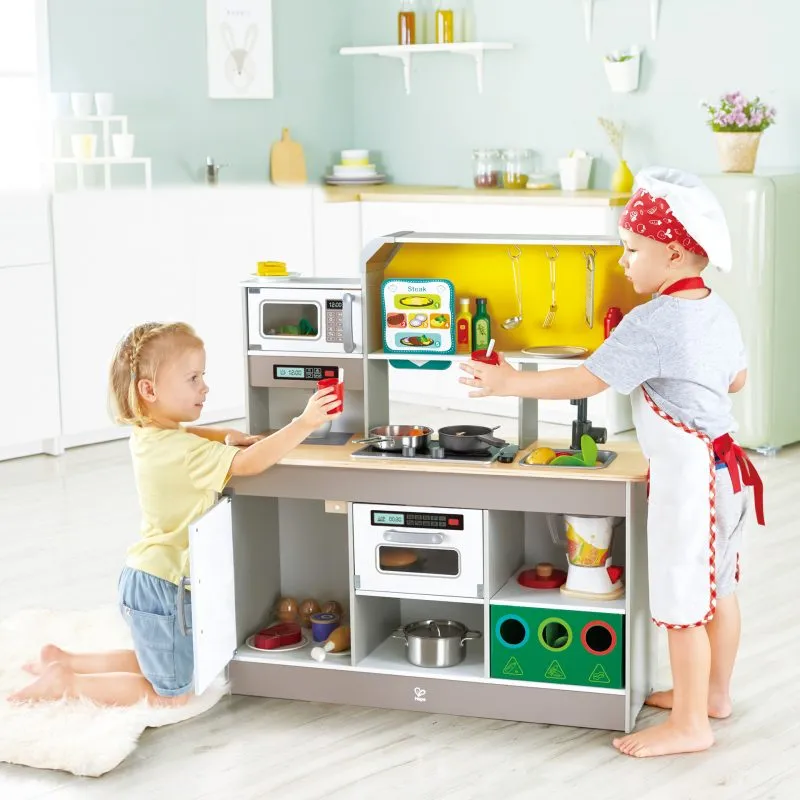
You can also share other activities with your children, such as arts and crafts. Talk about what makes the activity enjoyable, or ask whether anything funny or frustrating has happened lately.
Consistent positive communication benefits families in many ways. Children learn how to communicate with others and feel comfortable sharing their problems and ideas. This helps parents and caregivers get to know their children better. Read more in Playing with Your Child Helps Build Strong Family Relationships and Hugging Your Child Helps Strengthen Family Bonds.
If you are looking for a great developmental toy, Hape toys are a good choice, with a wide range of wooden toys that support children's development at every age.
Thoughtfully designed around how children learn, these toys help them practice essential skills such as looking, listening, observing, fine motor control, problem-solving, imagination, and creativity. They also support integrated STEAM learning.
Their sturdy designs and durable materials focus on supporting children's development while making safety a priority. With non-toxic colors and FSC-certified wood, they are durable, long-lasting, and environmentally friendly.
Hape is therefore a global wooden toy brand that prioritizes toy safety standards and environmentally conscious manufacturing.
It is easy to see how Hape wooden toys can enrich these activities and help children spend time away from screens.
What matters most is sharing happy moments as a family, because where there is love, there is a complete home! What activities do you enjoy with your child? 😁
Hape Thailand
Love Play Learn
🌐: Browse all products /hape-brand-page
Follow the latest news and special offers FB : Hape Thailand